Showing posts with label DM. Show all posts

Saturday, August 31, 2019

D&D things I like

Things I like on the player side:

Dungeoneering
Following NPCs to see what they do and how they think
Picking my PC’s plans
Puzzles
Genuine open-ended overland exploration
Lack of a story
The results of battles and skirmishes - not so much the playing them out
The results of romance - not playing it out - loves? Loss? Children?
Diseases
Finding and losing henchmen
Weird magic, even silly magic
My own character nearly dying
My own character dying appropriately

Things I like on the DM side:
Players who pick up the ball and run with it re: any of the above
Playing cool monsters
Making up cool magic items to find
Making up open-ended situations and seeing what the players think.
World-building


What do you like?

Tuesday, August 27, 2019

Descending Armor Class is Better

As long as Armor Class is a thing, I prefer descending armor class to ascending. I’ll explain.

In terms of ease of use, ascending is better. The math is easier. It’s easier to add than subtract. You know this is true intuitively even if it’s not strictly true for you. You see it among your friends. Ascending AC says, “add your attack bonus to d20 and compare.” So that’s a real easy mechanic. It’s easier than subtracting an armor class from your THAC0 and comparing. So in that sense ascending is better - it’s easier.

But there are two things that make descending AC better than ascending. 

The first one has to do with bounded accuracy and the arms race that happens with skills and stats in more modern editions. 

In D&D games prior to 3E, there were only 20 (or 21) armor classes. Just 20. There was AC 9, which was the worst, up to AC -10, which was the best. You couldn't get any better than the equivalent of AC 29 in an ascending system. 

But in the ascending systems of 3E and subsequent versions, your AC can go sky-high. You can have an AC of 40, 50, 100. What does that mean? It means that if someone wants to have a reasonable chance hit you, they need an attack bonus of some astronomical number as well. And the same is true for the DM's creations: Super high AC and super high BAB (base attack bonuses). 

Not so in descending. There's little reason for super inflation of attack bonuses because even an ancient red is only going to get up to a little less than AC 29.

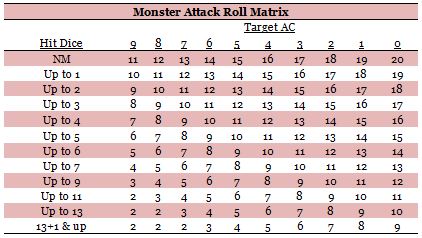
The second thing that makes descending AC is related to the first, but it's more of a player-side aid. That is, with only 20 steps to the AC scale, you can chart it very easily and put it where everyone can see it. It can be reduced to a chart rather than a math problem.  Here is the entire range of AC versus attack roll results in Mythical Journeys. This chart is based heavily on 0D&D:

Players


Monsters


That's it. No math and very simple charts. Click to enlarge as usual. Obviously the part that goes from -1 to -10 is missing here but it would be trivial to show it as well.

So you can actually make these math problems into charts for the math-challenged. After using them for one session, they will be really easy to use. 

Of these two reasons, I would say the bounded accuracy of descending AC is more important than the ease of its use because it kills off the arms race. It also means a guy at level 4 is not all that much better than a guy at 1, and not that much worse than a guy at 8. The difference is in resources (hit points, money) rather than in personal skill. And that keeps the characters feeling more realistic and less like superheroes.

Friday, August 23, 2019

1972

Consider the following.

The year is 1972. OD&D is almost two years away. We’re playing a game called “Blackmore” (or Greyhawk or Tekumel or Braunstein) where we have these great fictional characters exploring a great fictional world.

The characters have personality and appearance. We write down one or two cool things about them and maybe a weakness. Some stuff to make them human.

There is a setting. Perhaps it's the dungeon of a castle. Perhaps some expanse of foreboding forest (since every forest is foreboding and accursed.) You describe what you're going to do - no skill checks! And your referee adjudicates and describes what is happening.

The referee helps to narrate what happens at moments of conflict and uncertainty. Sometimes he asks for die rolls - generally, low is bad, high is good, and in the case of conflict, ties or near-ties require negotiation. But the results are really loosey-goosey and handwavey by the standards of our real decade. “Rulings, not rules” turned up to 11.

Are there rules? Game mechanics? Yes. But there’s no rule book (yet) so only the ref really knows what the game mechanics are. You have to trust the ref.  It’s a lot like the first time we all played - before we knew what the dice and tables meant.

Without hard stats, without hit points, without definite rules to lawyer over, you’re just this cool character exploring the world with your friends and perhaps rivals. The fiction is draped in front of the scaffolding of game mechanics. You just... play.

As you go along and things happen, you and the ref decide what numbers to write in, and even what categories there are: brains, guts, sex appeal, foot speed? It all depends on what’s been important so far. Who knows what “stats” you will think up.

The ref counts on you to direct the action. The world is alive and it’s turning whether you want to engage with it or not. It’s your show, not the ref’s. There’s no modules or story paths. They don’t even exist. Nobody’s standing there handing out quests when you click on an icon over their head. You gotta go hunt for adventure.

Would you like to play this way? Would you try it and try to get used to it? Would you turn your nose up?

I would like to play this way. Maybe not all the time but it would be a fun change of pace.

Incidentally, this isn't how I'm running my upcoming Port campaign. There is already enough of a gap between the new-school game the players are used to and the old-school game I'm going to run to make them try to make this mental leap as well. Maybe in a couple years we can try :)

Monday, August 19, 2019

"*a held missile impacts 2 steps after being fired"

Rick Stump, one of the more successful dungeon masters in the whole world, inadvertently published a few of his DM secrets on MeWe the other day. Your intrepid thief took down some notes and I'm presenting them to you today. Take a look at this gem from the inside of Rick's DM screen:

Click to enlarge

Sorry about the picture quality. It's extreme detail from a much larger image.

Anyway, look at the order of his combat Rounds. I'm surprised to see that spell casting goes the entire Round. Are you? And I'm thrilled to note the asterisk at the bottom: "a held missile impacts 2 steps after being fired."

This indicates that the archer can hold fire and loose it at a later point in the round, and that it takes time to adjudicate a a bow strike.

This makes a lot of sense. 

I've played it that a thrown weapon goes during the melee portion of the round. This has never been completely satisfactory, and the reason is now clear to me: thrown versus fired is a special effect thing, not a real mechanical distinction.

I really like how Rick orders his combat. Here's my current combat order: 

click to enlarge

In Port, I'm going to keep this chart in mind in case things go haywire, but I'm going to go with Rick's method and see what happens. It will look like this: 

click to enlarge


In addition to Rick's list, I've moved Morale to the bottom to better allow players to see surrenders and retreats coming and plan accordingly.

Incidentally, I fixed the numbering issue on the second Combat Round chart.

Friday, August 16, 2019

On the Emergent Nature of Story


I'm happy with this. It's something I wrote when I discovered that there were other people who played the old way and I've updated it only very slightly since. It's not a whole mission statement, but it's a part of one.


All games have rules & fiction. These do not have to be explicit. In the case of playing fetch with a dog, you & the dog know the rules even though the dog has no ability or method to explain them. In chess, the fiction is very thin. But there are no "real" chess men out there which the pieces represent, and you are not really "at war" with the other player.

In a Role-Playing Game specifically, players take turns gathering information & using that information to manage resources to transform scarce turns into other scarce game resources. While situationally-oppositional, players generally work together to achieve goals that are marginally greater than they could achieve individually.  For instance, players may bargain in splitting up the exposure to danger or the rewards gained.


The reward for this behavior is three-fold: in-game resources such as the gold piece; an expansion of the ability to manage resources through character growth (XP & levels), and finally a sense of wellbeing and camaraderie gained through collective success.  The first two rewards are game rewards; the latter one is a table reward.  All game rewards are ultimately subordinate to table rewards, or else players will cease to return to the table.

One player, the Referee, is set apart from the others by virtue of two distinctions:  one, asymmetrical information that the other players have not got; and two, he must simulate the opposition to the group by playing the monsters and describing the effects of traps, &c.

This distinction-- the simulation of opposition rather than actual opposition-- is important. It informs the participants that the Referee is not actually an opponent to the rest, but part of the team of players. Again, while there is situational opposition, the goal of the Referee is to experience the collective camaraderie of the team of players and not to thwart it even if the pieces he controls do thwart certain player actions!

Inasmuch as the Referee maintains this juxtaposition of both opposition & facilitation in his mind, the players (including him) will have a better go at the common table rewards they seek.

This is not an easy concept for the uninitiated; indeed, some Referees shall struggle mightily with their understanding and application of this juxtaposition.    

Let us examine how this role-within-a-role and game-within-a-game that the Referee plays came to be.

In the beginning, there were war-games.  Battles were re-enacted and the use of randomizers (dice) stood in for the Fog of War, as it were.  Tables, based upon real-world physics of machines of war and the real training levels of real soldiers, served as indicia of outcomes.  The men (and they were exclusively men) who played these war-games were military commanders.  They did not play for enjoyment or the thrill of competition, but as a teaching tool in order to prepare these men to lead real battles.  But these tables were incomplete; a Judge was necessary to adjudicate what flat and lifeless numbers could not.

The pieces—little men and tokens—were absolutely representative of actual men and actual machines.  The maps they used were absolutely representative as well.  These were no “fictional” wargames in the sense of Chess.  The rules were explicit, unlike playing fetch with a dog.  In fact, it is hard to say whether these original war-games were games at all.  The object was teaching exclusively.  The simulation allowed iteration at a reasonable cost in money and time rather than any extrinsic enjoyment.  Certainly the rewards gained were far-away in an intellectual sense from those rewards that we think of when we think of “games” today.

In time, some war-game historians and enthusiasts (the earliest we know of is H.G. Welles) divorced this teaching tool from its purpose, and re-purposed it for play. Rather later, war-games enthusiasts made another intellectual leap:  if war-games were no longer about teaching history and stratagems in real wars, then do they need to feature real wars at all?  They did not!  Further, do these war-games necessarily have to feature Man & Machine as they really exist, or shall they rather be allowed to simulate any sort of fantastic creature or device?  This leap of the imagination brought us to the shores of a whole new kind of pass-time.


And from this leap came the idea of the fantasy Hero leading a unit of Men and others in battle.  Eventually, some of the war-gamers rather fancied leaving the armies on the battlefield, and concentrating entirely on the Heroes themselves.  

These Heroes walked off the game board, delved into an ancient dungeon, and the rest is history.

So the Famous Game came to be; & so the Referee became not only an impartial judge of the action, but also simultaneously another equal player at the table.

How the Sausage Gets Made

Story is the goal of playing the game in its entirety; it is not the point of the rules themselves. Without the proper inputs, no set of rules will produce a suitable story.

Story emerges thusly:

The game world exists, brought into imaginary life by you, the Referee. It is largely independent of the Heroes; it is a thing unto itself until the Heroes begin to inhabit it.

Heroes act upon the game world.  Character actions are based on character motivations.  Character motivations change and grow, both in terms of what's going on in the game, and what's going on at (or away from) the table.

Thus far the division of creative labor in the making of the Story has fallen more or less evenly between the players of the Heroes and the Referee.  The Referee often puts in much more labor to create his part beforehand, while the players take up the lead during table time.

This is a process by which the players become entangled in some deep and inscrutable way with one another and a set of premises: there exists a Hero, he lives in this place, these are the events happening, &c; which you feed into a black box called "The Rules."  The rules spit out a different animus, and again, the entangled player-gestalt makes sense of the new animus.  


The sense they make is "The Story."

When the machine works well, players feel like it is magic. When it works poorly, players will seek to place blame- or even disengage from the process and shut that machine down.

As the referee, one job you have is to keep the black box functioning properly at the table, while the proverbial sausage is being made. You must know what subset the rules which you wish to use and where to find them (or have them in your mental catalogue.). You must make or be prepared to make rules which bridge gaps un-foreseen by this set of rules (i.e. create house rules).  You must jump into the breach instantly with your virtual tool-box and make rulings in real time when gears grind and sprockets spring.  And spring they will, at junctures shrouded from prognostication.

This aspect of the referee is essential to the creation of story.  This is your Role, and this guide will help you be ready to play it.


Scott Anderson
Seekonk, Massachusetts
20 May 2014