How common are clerics?
In AD&D and going forward the official literature seems to indicate that people are busting out with miracles left and right. Every village has a cure light wounds guy. Every city has a raise dead guy. And so forth.
The simulationist in me balks at this. The gamist balks too.
If you have a guy running around healing broken legs and so forth (or even curing diseases) then that’s going to change the demographics of a town. It also means that being irreligious or unobservant is kind of out. I mean, miracles left and right, right?
Same with clean water and safe food and a diminished fear of dark and frightful places fraught with disease and the restless dead. In other words, things are way less scary than maybe they should be. More folks would be adventurous and fewer would need to become adventurers. The world would be tame, which doesn’t fit with d&d at all.
Worldbuilding-wise it means that the assumptions of danger and fear of the unknown are diminished. It means fear of harm and death are diminished for the characters in their world.
And at the table, the same reduction in fear of harm means that the risk - that which creates meaningful drama - is also lessened. Less drama = less fun.
Therefore I have decided to make spell-using clerics rare and restrict them further than that, but also give common folks some pseudo-cleric power. Like so:
Not every religious figure can perform miracles (cast spells.) Just a very few special men and women can do it - people like Moses and Jesus and some of the prophets. In fact if you look at the early cleric spell list you will see an abundance of spells simulate miracles performed in the Bible. In fact clerics who can perform miracles might be outcasts, hermits, or otherwise viewed with suspicion. People may offer to pay them to teach the secrets of their tricks.
FURTHERMORE, and this is important, these clerics can’t just bust off miracles whenever they want to. On adventures they can. In dramatic situations they can. But they can’t just heal your broken leg in town or force you to tell the truth when haggling over the price of donuts. Miracles only happen when you really need them.
But on the upside, clerics of all kinds have a chance to diagnose monsters from their studies, knowing something useful about a strange beast on 3-6 on d6. Turning is also linear rather than with a 2d6 triangle-shaped probability distribution so it’s more likely they can turn higher-level bad guys.
For lay people, if they are Lawful and attend church, they can hold undead, demons and devils at bay with a holy symbol as a cleric of half their level. They can’t turn or destroy these entities but can hold them away indefinitely.
That’s how I do it. PC clerics are still powerful; churches function mostly as they do in real life; and commoners have a fighting chance against monsters as they come up.
Showing posts with label rules. Show all posts
Showing posts with label rules. Show all posts
Tuesday, September 17, 2019

Saturday, September 14, 2019
Knock Out Rules in D&D
Knock out rules in D&D have always been stinky and I don't really know how to fix that. At my table, if a person takes any hit point damage from nonlethal sources and then goes to 0 or less, he's actually knocked out instead of made to be dead. But that's really not a great solution for when someone "gets the drop on ya" or whatever and just konks you on the head.
Not that it comes up a lot but I'd hate for some of my players to not try it because the rules are written in a stinky way.
SO here is one solution I saw on MeWe but I can't remember to whom I should attribute it.
The Saps and Blackjacks Rule
On a surprise attack or a backstab attempt from behind with a sap or blackjack or improvised blunt weapon (referee's discretion), the target takes 1d6 nonlethal HP and throws a Save versus Paralyzation. If the target fails the save, he is knocked out for 1d6 Turns (10-60 minutes.)
Having significantly nonhuman physiology (like no head or no bones), being 6 HD or greater, or wearing a helmet will negate the necessity for this save.
1. Who wrote this rule? I honestly can't remember.
2. What do you think about it?
Friday, September 13, 2019
Learning D&D
What’s the best way to learn D&D?
In my opinion there are three stages of learning so there are three answers.
The first stage - just playing - is so elementary than nearly everyone comes equipped with the knowledge to do it. You consider the situation and your character and then you say what your character will do. Someone else handles the rules.
The second stage - learning the rules - probably happens better at the table too. You figure out what dice to roll and why. But some people learn better from the book. And of course you can learn from people and from the book.
Lately (um, the last 20 years) though there’s a third way that’s invaluable and that’s to learn from lots and lots of other players online. I had always preferred to play in the OSR way even when I was trying to lay that play style over 3.X and 4E. Thankfully I found Dragonsfoot and realized not only was I not alone but it was OK to play old editions as well. Thank goodness!
The third stage - deep system learning I think I will call it - requires more than what’s in the books. While stage two is akin to memorizing algorithms to solve problems, stage three is like devising proofs and building new algorithms. One thing to do is to pull a system apart and make up your own neoclone or fantasy heartbreaker. When I did this, it seemed like everyone was redoing the Thief class as a warm up to making a whole new version of d&d but the Thief thing has fallen in popularity. But there will be some system or subsystem which gets your juices flowing to reverse engineer the whole thing and rebuild it in your own image.
I’m less sure about the steps to becoming a deep player or deep referee but in my mind’s eye the process must be similar, although more qualitative than quantitative. Some aspect of the actual play piques your interest enough to explore it, you learn all you can about it by deconstructing it, and then rebuild your own understanding of how it works for you and the several players.
Monday, September 9, 2019
Fair Poisons
What is a “fair” poison?
Even in OSR games where death is close at hand, it’s a real jerk move for a referee to put “Bang! You’re dead!” style threats in the game. At least as far as traps and dangers go, there ought to be some warning or clues beforehand that you’re dealing with bad mojo.
Sometimes the clue is the dungeon level or in the case of players who have played with you before, the type of wilderland hex they’re in (e.g. traveling in the swamp in OD&D is just bad news.)
Sometimes it can be explicit, like when the referee says, “Ohhh... are you sure you want to pick up that chalice? You can feel dread emanating from the purple stone altar.”
Sometimes the ref can give clues based on body language of NPCs. “Your goblin looks at the ceiling, slides to the side of the passage, and slowly edges forward against the wall.”
But many times the prepared players will have a good chance to pick up and avoid dangers simply by following stands procedures: a sneaky forward scout, ten-foot pole, examining doors for traps, using lockpicks, whatever you think is appropriate to be sufficiently prepared.
Preparation can happen prior to the delve too. For instance if the players are entering the Snake Pits of Set, they should know enough to pack antivenom and a Cure Disease scroll.
Poison is potentially different though. Someone might poison a PCs food. A needle trap or mantrap may be enhanced with poison. Air might be toxic or noxious. A potion may be poison rather than beneficial. These are real threats that are hard to detect.
I don’t know the answer. I do know that an unfair poison is one that kills instantly with little possibility of detection or handy cure. Even a poison which makes some permanent, negative change to a character can be fair if your players are willing to accept it. What do you think?
.
Tuesday, August 27, 2019
Descending Armor Class is Better
As long as Armor Class is a thing, I prefer descending armor class to ascending. I’ll explain.
In terms of ease of use, ascending is better. The math is easier. It’s easier to add than subtract. You know this is true intuitively even if it’s not strictly true for you. You see it among your friends. Ascending AC says, “add your attack bonus to d20 and compare.” So that’s a real easy mechanic. It’s easier than subtracting an armor class from your THAC0 and comparing. So in that sense ascending is better - it’s easier.
But there are two things that make descending AC better than ascending.
The first one has to do with bounded accuracy and the arms race that happens with skills and stats in more modern editions.
In D&D games prior to 3E, there were only 20 (or 21) armor classes. Just 20. There was AC 9, which was the worst, up to AC -10, which was the best. You couldn't get any better than the equivalent of AC 29 in an ascending system.
But in the ascending systems of 3E and subsequent versions, your AC can go sky-high. You can have an AC of 40, 50, 100. What does that mean? It means that if someone wants to have a reasonable chance hit you, they need an attack bonus of some astronomical number as well. And the same is true for the DM's creations: Super high AC and super high BAB (base attack bonuses).
Not so in descending. There's little reason for super inflation of attack bonuses because even an ancient red is only going to get up to a little less than AC 29.
The second thing that makes descending AC is related to the first, but it's more of a player-side aid. That is, with only 20 steps to the AC scale, you can chart it very easily and put it where everyone can see it. It can be reduced to a chart rather than a math problem. Here is the entire range of AC versus attack roll results in Mythical Journeys. This chart is based heavily on 0D&D:
Players

Monsters
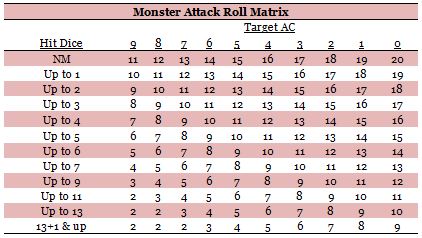
That's it. No math and very simple charts. Click to enlarge as usual. Obviously the part that goes from -1 to -10 is missing here but it would be trivial to show it as well.
So you can actually make these math problems into charts for the math-challenged. After using them for one session, they will be really easy to use.
Of these two reasons, I would say the bounded accuracy of descending AC is more important than the ease of its use because it kills off the arms race. It also means a guy at level 4 is not all that much better than a guy at 1, and not that much worse than a guy at 8. The difference is in resources (hit points, money) rather than in personal skill. And that keeps the characters feeling more realistic and less like superheroes.
Monday, August 26, 2019
On Fantasy Languages
We played Session Zero of the Fallen Empire campaign on Saturday. It went very well. I found in some cases I was over-prepped and in a couple cases I was under-prepped. In the last couple of days I've set out to solve some of those under-preps and potentially head off some similar issues. In addition, I've gone from two box of note cards down to one, finding that the monster manual I have in my big binder of stuff is more than sufficient and I don't need my monster manual on note cards. That's actually a huge deal.
One of the picayune issues that came up is, "What's some good languages for my character to know?" Every campaign is different and every ref adjudicates the importance of talking differently. I want my players to take care not to rush into a fight every time, even when confronted with monsters. Therefore languages are very important. Delta's post from just this morning spurred me to talk about this particular aspect of Saturday's table time.
in Mythical Journeys, I do make a point of spending time talking about language and suggesting some that would work well in such a setting. But that's generic and this is specific. I will choose some languages now to suggest to the players.
Note: these are the suggested languages; the ones you would get the most use out of. There are doubtless thousands of spoken and written languages; some dead and some living in some weird corners of the Realm.
Race Languages:
1. Dwarven (gnomish is a dialect.)
2. Elven
3. Goblin (goblins, hobgoblins and bugbears)
4. Draconic (dragons and similar creatures with linguistic capacity)
5. Giant (including ogres and trolls)
Alignment Languages:
6. Simite (Lawful)
7. Achromatic (Neutral Alignment)
8. Vitian (Chaotic)
Outsider Languages:
9. Celestial (Good)
10. Infernal (Lawful)
11. Abyssal (Chaotic)
Infernal is very, very, very specific. It is the language chiefly of Devils. It is rarely if ever spoken by Men of the Realm but important contracts are written in Infernal as well as Common and/or Dwarven.
Celestial and Abyssal are superglottal languages. Men have not the ability to speak it, though they may learn to understand their aural form. Audible Celestial forces evil creatures to check morale or cower in awe. Audible Abyssal does the same for Lawful creatures. (Note: A creature may be both Lawful and evil.)
Pidgins:
12. Common (men and hobbits)
13. Sylvan (forest creatures)
14. Undercommon (kobolds and subterranean beings)
Secret Languages:
15. Thieves' Cant
16. Druidic
Secret Languages are not available to most characters at creation except for those characters who are part of the organizations which use them.
Tuesday, August 20, 2019
Making Bows More Interesting
Now that we have established that a “Round” zips by at the speed it must and no zippier, let’s talk about rate of fire. And while we’re at it, let’s jazz up conventional bows a bit.
In CHAINMAIL, archers who were not disturbed and did not make a move were awarded two attacks in a Round. In fact in 1st edition AD&D gives the bow’s ROF as 2:1.
Remember how we were saying archers were pretty speedy even in the chaos of a melee? Let’s give the bowman 2:1 under ideal circumstances. Those circumstances are: not making a move and not being engaged in melee. So under those conditions he’s whizzing off two good shots a Round.
But what if he is being engaged in melee?
That’s bad. Not only is he only firing off one shot, but he should have some other penalties to compensate for his speedy delivery.
How about one arrow, at -4 to hit, and also -2 to AC because he’s jostling for the shot? And furthermore he can’t attempt a point-blank shot. That would be one way to go.
Another way would be to say he can’t get a shot off at all because he’s being harassed and has to fight for his life. I rather think this is the way to go. The archer has to toss his bow behind him and grab up a proper weapon to fend off an attacker. On the other hand, he can have a move.
Therefore we shall go with the second of these: no attacks and must defend, but still gets the move.
In my mind’s eye, I see this configuration encouraging formations where fighting-men, Demi-men and clerics would cover an angle of enemy attack to give the bowman two clear shots per round.
Crossbows would not work like this. First, crossbows take longer to load. Second, they can be used point-blank once loaded. So neither the bonuses or penalties of the bow would apply to crossbows.
What do you think?
Monday, August 19, 2019
"*a held missile impacts 2 steps after being fired"
Rick Stump, one of the more successful dungeon masters in the whole world, inadvertently published a few of his DM secrets on MeWe the other day. Your intrepid thief took down some notes and I'm presenting them to you today. Take a look at this gem from the inside of Rick's DM screen:
 |
| Click to enlarge |
Sorry about the picture quality. It's extreme detail from a much larger image.
Anyway, look at the order of his combat Rounds. I'm surprised to see that spell casting goes the entire Round. Are you? And I'm thrilled to note the asterisk at the bottom: "a held missile impacts 2 steps after being fired."
This indicates that the archer can hold fire and loose it at a later point in the round, and that it takes time to adjudicate a a bow strike.
This makes a lot of sense.
I've played it that a thrown weapon goes during the melee portion of the round. This has never been completely satisfactory, and the reason is now clear to me: thrown versus fired is a special effect thing, not a real mechanical distinction.
I really like how Rick orders his combat. Here's my current combat order:
 |
| click to enlarge |
In Port, I'm going to keep this chart in mind in case things go haywire, but I'm going to go with Rick's method and see what happens. It will look like this:
 |
| click to enlarge |
In addition to Rick's list, I've moved Morale to the bottom to better allow players to see surrenders and retreats coming and plan accordingly.
Incidentally, I fixed the numbering issue on the second Combat Round chart.
Incidentally, I fixed the numbering issue on the second Combat Round chart.
Wednesday, August 14, 2019
On the Profits and Expenses of an Adventuring Company
This is interesting.
I've been thinking about the players who will be at the table for my upcoming Fallen Empire campaign. It at-this-very-moment appears that the several players want to start with a megadungeon style campaign of mostly episodic forays into Castle Triskelion. The last campaign we just finished was an epic sweep through the Realm fighting for the future of the free peoples of that realm and so forth; rescuing gods and fighting battles with a cast of tens of thousands.
The usual.
So now my bloodthirsty and goldlusting players want something more visceral and down in the trenches.
Cool.
There is literally no way to forsee all the problems we will have at the table (in the dungeon? Yeah, I've got that.) But based on what I know about the personalities of the several players, it's going to be important to get them thinking about how expenses are paid and how treasure is divided up. This is a gold-for-XP game with a hint of HD-for-XP for flavor. The distribution of financial resources will be critical.
Therefore I have written a contract. The fiction is, any group of adventurers needs a patron to raid this particular megadungeon. If they don't have one, they will be fair game for other groups both in the dungeon and for the authorities in town.
The reason for the fiction is, I want to make sure that more aggressive and/or avaricious players do not take advantage of more agreeable and/or generous ones. It's all there in black and white and they all sign on ahead of time which should prevent many hurt feelings later on.
If the players want to, they can suggest changes to the document at the time we ratify it, but I'll keep veto power over those changes.
Here is the text of the document. Please look carefully at sections 3.b.v subsections 1 and 2; this is a decision the players need to make. Only 1 or 2 will be in effect at any time.
Ledger
Agreement
1)
Section 1: Definitions
a)
A SHAREHOLDER is a PC member of the Adventuring
COMPANY.
b)
COMPANY is the sum of all PCs adventuring
together.
c)
PATRON is the warranting organization which
makes a COMPANY official.
i)
A warranted COMPANY will have legal concerns
handled by the PATRON.
ii)
A warranted COMPANY is at liberty to keep what
it salvages from
(1)
areas outside of normal human occupation and
(2)
contested areas within the areas of human
occupation.
d)
A HENCHMAN is a contract worker, subordinate to
an individual SHAREHOLDER, who works for a set amount of money for a short
period, usually one adventuring session.
i)
The Referee will decide whether orders given to
these types will be followed.
ii)
Some contract workers are not HENCHMEN; only
those who agree to enter the dungeon are counted as HENCHMEN for the purposes
of this document.
iii)
Elfs will not Hench for Dwarfs and Dwarfs will
not Hench for Elfs. No exceptions.
e)
A RETAINER is a special NPC who functions as a
sidekick and special assistant to a PC for a long period of time and is usually
but not always played by the same player as that PC.
i)
The Referee has final say on any questionable
Retainer actions.
ii)
Some NPCs such as loyal animals or subordinate
monsters will count as Retainers for some purposes, but will never count for
the purposes of dividing up treasure. They are compensated as the PC sees fit.
f)
An ADVENTURE is the time SHAREHOLDERS are
together on official business for their COMPANY PATRON.
g)
A CONSENSUS is achieved if all living, attending
members of a COMPANY are present and agree upon a measure.
h)
REIMBURSEMENT means that the COMPANY pays costs
i)
and then submits receipts to the PATRON,
ii)
which will then pay some or all of those
expenses
iii)
based on agreements made below.
i)
INSPECTION means that the COMPANY submits items
to the PATRON for the purposes of examination and cataloguing.
i)
INSPECTION will last no more than ten days
excepting Sundays and Holidays and no more than 13 days in any case.
ii)
Objects so inspected remain the sole property of
the COMPANY in the interim.
iii)
Objects subject to INSPECTION are magic items
found or won in the course of Adventuring as a COMPANY.
iv)
The PATRON reserves the right of first refusal
on any sale of items so INSPECTED.
(1)
Such sales are not subject to a 10% PATRON fee
(2)
And do award XP for gold.
2)
Section 2: Expenses
a)
Before PCs are paid they must pay expenses.
i)
A warranted Company pays its patron 10% of all
takings.
ii)
The Company submits all magic items for
inspection. Magic items will be returned to the Company after inspection.
b)
Paying NPCs.
i)
Henchmen.
(1)
The Henchman is paid up-front before the
adventure by the individual PC employing him. No exceptions.
(2)
The Henchman is not entitled to any percentage
of the take.
(3)
Then Henchman is not entitled to any magic items
found.
(4)
After the adventure, a surviving Henchman will
divest himself of all gear the PC has given to him for the adventure.
(a)
If the PC wishes for the Henchman to keep that
gear, the PC will say so upon its return.
(5)
Then the Henchman will depart and immediately
Squander all money earned.
(6)
A dead hireling of any kind, including henchmen,
is awarded 25 gp for his next of kin. No exceptions.
(a)
This payment applies even if he is later brought
back to life and is non-refundable.
(b)
If his PC employer cannot afford it, the PC will
be given a loan by the Company patron at 10% interest compounded four times per
year.
c)
Other Expenses
i)
A dead PC gets 25 gp for his next of kin. No
exceptions. This payment is made by the remaining living shareholders of the
Company.
ii)
This payment applies even if he is later brought
back to life
(1)
and is non-refundable.
(2)
If the Company cannot afford it, the Company
will be given a loan by the Company patron at 10% interest compounded four
times per year.
iii)
A PC made to be Cursed or otherwise fallen ill by magical means will be cured at
the Company’s expense.
(1)
This payment will be made. If the Company cannot
afford it, the Company will be given a loan by the Company patron at 10%
interest compounded four times per year.
(2)
If this is an officially-warranted Company, the
cost of this procedure will be reimbursed up to 50% by the Company patron.
iv)
By consensus of the surviving Shareholders, and
at their expense, a PC made dead may be Raised or brought back to life in some
way.
(1)
This decision must be made by consensus among
surviving shareholders.
(2)
If you are an officially-warranted company, the
cost of this procedure will be reimbursed up to 50% by the Company patron.
v)
By consensus of the Shareholders and at their
expense, gear used by the Company may be replaced or purchased from this money.
(1)
These expenses may include but are not limited
to: replacing or acquiring new
(a)
Holy Water, Flaming Oil, dungeon dogs, pack
animals, vehicles, and specialty dungeoneering equipment.
3)
Section 3: Compensation
a)
Money
i)
For the purposes of this section, “Money” will
be defined as all items of value salvaged
(1)
including art, jewelry, trade goods, furniture,
non-magical gear, etc.
ii)
In the case of no SHAREHOLDER having a RETAINER,
(1)
All money which remains after expenses are paid
will be split evenly among SHAREHOLDERS of the COMPANY.
iii)
In the case of one or more SHAREHOLDERS having
one or more RETAINERS,
(1)
Divide the remaining money into equal shares
such that
(a)
SHAREHOLDERS get two shares and
(b)
RETAINERS get one share.
(2)
Award each SHAREHOLDER two shares and each
RETAINER one share.
(3)
Do not count monstrous or pet retainers in these
calculations.
iv)
All RETAINERS and SHAREHOLDERS are paid
simultaneously.
b)
Magic Items
i)
Magic Items award no XP. Magic is its own
reward.
ii)
If a Magic Item is sold immediately after the
Adventure and not kept or used, the proceeds will count toward XP.
(1)
This sale is not subject to the normal 10%
payment to the PATRON.
iii)
Those Magic Items which are kept shall be
awarded to one or another PC.
(1)
The awardee may then do with it as he pleases,
but selling it awards no XP.
iv)
Magic Items are awarded when other treasure is
awarded after the award of Money.
v)
A Magic Item shall be awarded by the following
method:
(1)
By chance, as rolled on dice
(2) By
auction. If so the auction will proceed in this manner:
(a)
Each SHAREHOLDER may bid Money for the item.
(b)
Once the high bid has been decided, that
SHAREHOLDER gets the item.
(c)
The SHAREHOLDER pays the Money to the COMPANY
(i)
Once all Magic Items have been so awarded,
(ii)
The COMPANY pays the Money out equally to all
SHAREHOLDERS (including those who placed winning bids.)
c)
Services and Other Unusual Awards
i)
Those awards which do not have an obvious cash
value shall be awarded by the same method detailed under (3.b.v.)
Subscribe to:
Posts (Atom)