Thinking out loud.
Rather than take initiative down each Round, what if we were to imagine that each side moved, shot and swung at the same time?
In wargames, it is a fairly common practice for each side to write orders, submit them, and then make simultaneous action. Each action is completed. Even if a figure is killed, it still gets to make its attack against the other side. At the end of the Round when otherwise checking morale we will also check for death.
The tricky thing is for the referee, running the several monsters, to stay honest. Perhaps it makes more sense for him to adjudicate monster actions first? I don’t know.
So rather than taking down initiative round by round, the process would be:
Each side marks down the general action each figure will attempt (melee, missile, spell, full move, misc.) and then everyone reveals their card simultaneously.
That’s a lot of cards. It may get really clunky at the table. But it seems like a fascinating way to go.
Then each action is executed sequentially in real time but considered simultaneous in the characters’ realm.
Finally we will check for status effects such as morale, death, ensorcelment, poison, etc.
Too fiddly? Has anyone done it this way?
Tuesday, September 10, 2019

Monday, September 9, 2019
Fair Poisons
What is a “fair” poison?
Even in OSR games where death is close at hand, it’s a real jerk move for a referee to put “Bang! You’re dead!” style threats in the game. At least as far as traps and dangers go, there ought to be some warning or clues beforehand that you’re dealing with bad mojo.
Sometimes the clue is the dungeon level or in the case of players who have played with you before, the type of wilderland hex they’re in (e.g. traveling in the swamp in OD&D is just bad news.)
Sometimes it can be explicit, like when the referee says, “Ohhh... are you sure you want to pick up that chalice? You can feel dread emanating from the purple stone altar.”
Sometimes the ref can give clues based on body language of NPCs. “Your goblin looks at the ceiling, slides to the side of the passage, and slowly edges forward against the wall.”
But many times the prepared players will have a good chance to pick up and avoid dangers simply by following stands procedures: a sneaky forward scout, ten-foot pole, examining doors for traps, using lockpicks, whatever you think is appropriate to be sufficiently prepared.
Preparation can happen prior to the delve too. For instance if the players are entering the Snake Pits of Set, they should know enough to pack antivenom and a Cure Disease scroll.
Poison is potentially different though. Someone might poison a PCs food. A needle trap or mantrap may be enhanced with poison. Air might be toxic or noxious. A potion may be poison rather than beneficial. These are real threats that are hard to detect.
I don’t know the answer. I do know that an unfair poison is one that kills instantly with little possibility of detection or handy cure. Even a poison which makes some permanent, negative change to a character can be fair if your players are willing to accept it. What do you think?
.
Wednesday, September 4, 2019
Cleaned Up the Sidebar
Murlynd's Spoon lost about 20 listings: I canned almost everything older than a year old and some other sites that are just advertising stuff. Also added two blogs that should have been there all along.
Greyhawk Grognard and Paul Gorman's Devilghost.
Greyhawk Grognard and Paul Gorman's Devilghost.
Tuesday, September 3, 2019
Port: University District
I've got two players (out of 5) who are members of the University. One is Simone's magic-user and the other one is Ethan's fighting-man, both level 3. Since there are two players I sent them off a copy of the map with the neighborhoods numbered.
I wanted each of them to pick out one of them and tell us about it. As it turns out, Ethan did all the neighborhoods. I cleaned it up very minimally to keep it in line with the campaign world.
I think a neighborhood can have up to 5,000 people in it, although many neighborhoods are completely devoid of residences. There are some neighborhoods that are not even controlled by people at all. Ethan did a good job of keeping this in mind in his write up.
 |
| The University District |
26. Drenthe. The main grounds of the University
are located here. This is where magic users of all levels come to train, study
and practice the art of magic. Furthermore, Special/unique magic items
can be purchased here but they cost a lot of gold or trade. There are excellent
libraries but their use is costly to keep commoners out. There are surely some
relics stored here. Matron Bat-Sheva, the Headmistress, lives in a country
cottage on the southern beach.
27. North Brabant.
28. Gelder.
Areas 27 and 28 are mostly dormitories for students
and workers. A good bed can be had for a good price but a single dwelling is
expensive. In area 27, known as North Brabant or NB, there is a famous tavern
called The Sword of Stars where adventuring wizards and their retinue may be
found. Additionally, ferries from Aldgate (32a) debark.
Area 28, Gelder, is where low level magic users
live in a residential district with few services. A wildcatter Orcish ferryman
named Cassius will take you between Gelder, Gillamore and Montenon (13) but
only at night, and even to (Unnamed Neighborhood) (44) for a pretty penny.
29. Gillamore. Gillamore is where most forms of
trade occur in the University. It is where ferries from Cobisou (9) and
Bouzille (10) arrive. Here you can trade items for gold, buy and sell
equipment, weapons, armor, etc. The main bank of the University is also located
in Gillamore, where you can store treasure if you wish. Everything an
adventurer needs can be found in the shops of Gillamore, but there are few magic
items for sale here. Additional adventurers and henchmen can also be found here. Some are desperate
for work and any form of currency while others charge a premium for their
services.
30. Axminster. There are several barracks and
housing units here, both attached to the University and independent. A large
number of fighting-men and men-at-arms live here. There are guild halls and
every alleyway has a pub. There is a large common area here where sheep and
cattle graze while men practice and drill with individual weapons and formation
fighting. Sometimes fighting-men and magic-user will drill together in wartime
tactics.
31. Overjissel. Overjissel is known for its
magical resources. There is a chance that if you have the money, you can find
even advanced magic items such as staves and wondrous items. If you wish,
magical items can also be sold here. It is a well-known neighborhood in the
University and it is full of friendly folk, mostly lawful.
However, one of the shops is owned by a mid-level
magic user who is currently out of favor with the leadership. He doesn't have
anything of much interest in his shop, so it is not frequently visited. He can
be hired for adventures and is desperate for money. His name is Renoldus (MU6),
and his shop is called North Star. Another shop is Twin Sun Magic, where
magical items of all sorts can be bought and sold. The shop is famous for high
quality items and everyone in the University has been there at least once and
knows the owner, Byrant Geradus (MU5 INT 18 CHA 15), who makes it a point to
remember everyone who enters his shop.
A ferry runs to Corbisou (9).
Saturday, August 31, 2019
D&D things I like
Things I like on the player side:
Dungeoneering
Following NPCs to see what they do and how they think
Picking my PC’s plans
Puzzles
Genuine open-ended overland exploration
Lack of a story
The results of battles and skirmishes - not so much the playing them out
The results of romance - not playing it out - loves? Loss? Children?
Diseases
Finding and losing henchmen
Weird magic, even silly magic
My own character nearly dying
My own character dying appropriately
Things I like on the DM side:
Players who pick up the ball and run with it re: any of the above
Playing cool monsters
Making up cool magic items to find
Making up open-ended situations and seeing what the players think.
World-building
What do you like?
Friday, August 30, 2019
Dweomercraft
Spells are caused by living things. They are called Dweomers, like the word that Gary said. There is a certain species of magic creature that causes the Sleep spell and a different one that Move Earths. Each spell had a different mover.
Based upon each one’s complexity, we hold them in a hierarchical taxonomy. There are spells of levels one through six, denoting strength and subtlety and that which needful men might use to call them to this place.
They come from other realms orthogonal to ours, but quite concomitant. The wizard coaxes them from there to here with the rhymes he scribes into his book of spells. The writing that he uses is unique in all the realms to that one hand. That is to say, each wizard makes a cypher up to keep his knowledge fast against depravities of other men. Together and collectively, these cyphers are referred to as asemic. Writs of the asemic kind are languages, but each has kenship of but one.
Then he completes the spell with another little rhyme and some dance steps. It invites a particular dweomer to come out and do its magic thing.
In the mean time, they live inside his brain and nervous system. Like, actually in his electrical neural pathways; living ghostfire. It jangles up the brain. Inviting the dweomers in without understanding them, without taking precautions, is both dangerous and counterproductive. You’re just asking for trouble and it’s almost certainly going to fail anyway. That’s why wizards have to study so long.
The basis of the arcane art is to first befriend and then to tame two particular dweomers: one of the kind that Reads Magic and the other of the kind that Detects Magic. Once the particular dweomercrafter masters the ellencraft and callingcraft of these two spells, he may start upon his career as a proper magic-user.
Even those who make these first two friends are not assured their due. It’s hard to keep a lot of dweomers in there at once. You see, they all vibrate at different frequencies. One or two might be almost pleasant, like the buzz of some insects. But if you keep many confined at once, they will make quite a mental racket indeed! So you can see how many older wizards are absent-minded or even go quite mad.
The barriers between the Realms are constructed from these dweomers. When passing through them, wizards and powerful outsiders coax them or intimidate them to move away.
Tuesday, August 27, 2019
Descending Armor Class is Better
As long as Armor Class is a thing, I prefer descending armor class to ascending. I’ll explain.
In terms of ease of use, ascending is better. The math is easier. It’s easier to add than subtract. You know this is true intuitively even if it’s not strictly true for you. You see it among your friends. Ascending AC says, “add your attack bonus to d20 and compare.” So that’s a real easy mechanic. It’s easier than subtracting an armor class from your THAC0 and comparing. So in that sense ascending is better - it’s easier.
But there are two things that make descending AC better than ascending.
The first one has to do with bounded accuracy and the arms race that happens with skills and stats in more modern editions.
In D&D games prior to 3E, there were only 20 (or 21) armor classes. Just 20. There was AC 9, which was the worst, up to AC -10, which was the best. You couldn't get any better than the equivalent of AC 29 in an ascending system.
But in the ascending systems of 3E and subsequent versions, your AC can go sky-high. You can have an AC of 40, 50, 100. What does that mean? It means that if someone wants to have a reasonable chance hit you, they need an attack bonus of some astronomical number as well. And the same is true for the DM's creations: Super high AC and super high BAB (base attack bonuses).
Not so in descending. There's little reason for super inflation of attack bonuses because even an ancient red is only going to get up to a little less than AC 29.
The second thing that makes descending AC is related to the first, but it's more of a player-side aid. That is, with only 20 steps to the AC scale, you can chart it very easily and put it where everyone can see it. It can be reduced to a chart rather than a math problem. Here is the entire range of AC versus attack roll results in Mythical Journeys. This chart is based heavily on 0D&D:
Players

Monsters
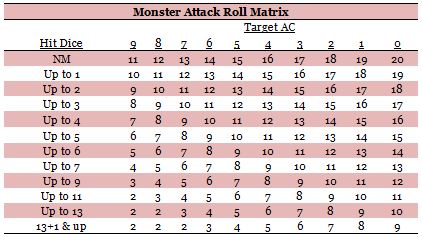
That's it. No math and very simple charts. Click to enlarge as usual. Obviously the part that goes from -1 to -10 is missing here but it would be trivial to show it as well.
So you can actually make these math problems into charts for the math-challenged. After using them for one session, they will be really easy to use.
Of these two reasons, I would say the bounded accuracy of descending AC is more important than the ease of its use because it kills off the arms race. It also means a guy at level 4 is not all that much better than a guy at 1, and not that much worse than a guy at 8. The difference is in resources (hit points, money) rather than in personal skill. And that keeps the characters feeling more realistic and less like superheroes.
Monday, August 26, 2019
On Fantasy Languages
We played Session Zero of the Fallen Empire campaign on Saturday. It went very well. I found in some cases I was over-prepped and in a couple cases I was under-prepped. In the last couple of days I've set out to solve some of those under-preps and potentially head off some similar issues. In addition, I've gone from two box of note cards down to one, finding that the monster manual I have in my big binder of stuff is more than sufficient and I don't need my monster manual on note cards. That's actually a huge deal.
One of the picayune issues that came up is, "What's some good languages for my character to know?" Every campaign is different and every ref adjudicates the importance of talking differently. I want my players to take care not to rush into a fight every time, even when confronted with monsters. Therefore languages are very important. Delta's post from just this morning spurred me to talk about this particular aspect of Saturday's table time.
in Mythical Journeys, I do make a point of spending time talking about language and suggesting some that would work well in such a setting. But that's generic and this is specific. I will choose some languages now to suggest to the players.
Note: these are the suggested languages; the ones you would get the most use out of. There are doubtless thousands of spoken and written languages; some dead and some living in some weird corners of the Realm.
Race Languages:
1. Dwarven (gnomish is a dialect.)
2. Elven
3. Goblin (goblins, hobgoblins and bugbears)
4. Draconic (dragons and similar creatures with linguistic capacity)
5. Giant (including ogres and trolls)
Alignment Languages:
6. Simite (Lawful)
7. Achromatic (Neutral Alignment)
8. Vitian (Chaotic)
Outsider Languages:
9. Celestial (Good)
10. Infernal (Lawful)
11. Abyssal (Chaotic)
Infernal is very, very, very specific. It is the language chiefly of Devils. It is rarely if ever spoken by Men of the Realm but important contracts are written in Infernal as well as Common and/or Dwarven.
Celestial and Abyssal are superglottal languages. Men have not the ability to speak it, though they may learn to understand their aural form. Audible Celestial forces evil creatures to check morale or cower in awe. Audible Abyssal does the same for Lawful creatures. (Note: A creature may be both Lawful and evil.)
Pidgins:
12. Common (men and hobbits)
13. Sylvan (forest creatures)
14. Undercommon (kobolds and subterranean beings)
Secret Languages:
15. Thieves' Cant
16. Druidic
Secret Languages are not available to most characters at creation except for those characters who are part of the organizations which use them.
Friday, August 23, 2019
1972
Consider the following.
The year is 1972. OD&D is almost two years away. We’re playing a game called “Blackmore” (or Greyhawk or Tekumel or Braunstein) where we have these great fictional characters exploring a great fictional world.
The characters have personality and appearance. We write down one or two cool things about them and maybe a weakness. Some stuff to make them human.
There is a setting. Perhaps it's the dungeon of a castle. Perhaps some expanse of foreboding forest (since every forest is foreboding and accursed.) You describe what you're going to do - no skill checks! And your referee adjudicates and describes what is happening.
The referee helps to narrate what happens at moments of conflict and uncertainty. Sometimes he asks for die rolls - generally, low is bad, high is good, and in the case of conflict, ties or near-ties require negotiation. But the results are really loosey-goosey and handwavey by the standards of our real decade. “Rulings, not rules” turned up to 11.
Are there rules? Game mechanics? Yes. But there’s no rule book (yet) so only the ref really knows what the game mechanics are. You have to trust the ref. It’s a lot like the first time we all played - before we knew what the dice and tables meant.
Without hard stats, without hit points, without definite rules to lawyer over, you’re just this cool character exploring the world with your friends and perhaps rivals. The fiction is draped in front of the scaffolding of game mechanics. You just... play.
As you go along and things happen, you and the ref decide what numbers to write in, and even what categories there are: brains, guts, sex appeal, foot speed? It all depends on what’s been important so far. Who knows what “stats” you will think up.
The ref counts on you to direct the action. The world is alive and it’s turning whether you want to engage with it or not. It’s your show, not the ref’s. There’s no modules or story paths. They don’t even exist. Nobody’s standing there handing out quests when you click on an icon over their head. You gotta go hunt for adventure.
Would you like to play this way? Would you try it and try to get used to it? Would you turn your nose up?
I would like to play this way. Maybe not all the time but it would be a fun change of pace.
Incidentally, this isn't how I'm running my upcoming Port campaign. There is already enough of a gap between the new-school game the players are used to and the old-school game I'm going to run to make them try to make this mental leap as well. Maybe in a couple years we can try :)
Incidentally, this isn't how I'm running my upcoming Port campaign. There is already enough of a gap between the new-school game the players are used to and the old-school game I'm going to run to make them try to make this mental leap as well. Maybe in a couple years we can try :)
Thursday, August 22, 2019
Port, the City of the Fallen Empire
This is a map of the city. This map is not to scale. It's more like a subway map. But it's here for you to see and I'm very pleased with it.

Areas under control:
Brown: House Aearchus
Green: Dockworkers Guild
Yellow: Merchants' Guild
Blue: House Iulus
Pink: The University
Orange: House Tibulus
Purple: Weights and Measures Guild
Beige: Not controlled or uninhabited.
Center: House Triskelion (extinct).
Subscribe to:
Posts (Atom)